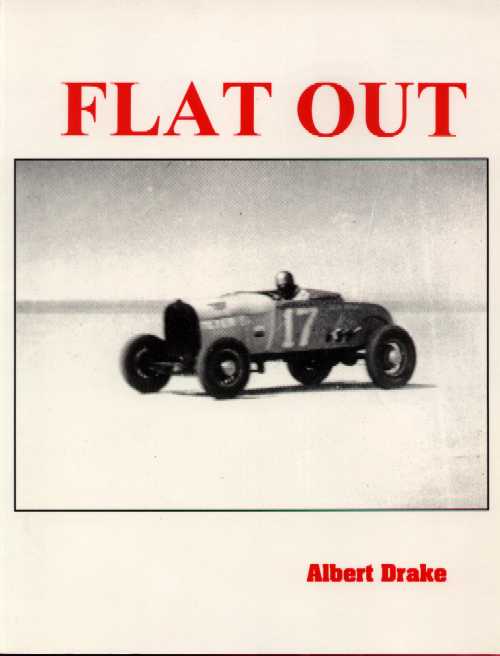
When there were far fewer people around, far fewer laws and regulations, when the legal speed limit was 75 mph, when gas was cheap, when driving was a pleasure, if you owned a hot machine you could point the grill down an empty road and go!

Portland Pictorial Review

There's also nice review of Portland Pictorial by Richard Parks at HotRodHotLine.com.
"The photos and their captioned stories provide us with a great deal of history. It’s just that the readers have to dig it out for themselves, bit by bit. The format of Portland Pictorial, The 1950s is similar to benchracing with the gang on Saturday night, thumbing through the local hot rod club’s photo album and relishing the memories."
 He also has reviewed Hot Rodder!, mentioning that it's not a slick book, but it
"...more than make(s) up for it in the quality of the text, research, photographs and sheer exuberance in loving the sport of hot rodding and land speed racing. Drake is first and foremost a fan of motorsports and it is his love and loyalty that shines through loud and clear."
Thanks Richard!

Reblog this post [with Zemanta]

Dick Larrowe's '34 Chev Coupe

In 1952 Dick Larrowe cruised around Portland, Oregon in this 1934 Chevrolet coupe. It was lowered, had home-made fender skirts, painted WSW and a cut-down spare. A few months later Dick cut the top off, made it into a roadster with home-made cloth top.
In the 1980s Dick started Stovebolt Engineering. He currently has a couple hot rods with in-line Chev/GMC engines.
Enhanced by Zemanta

Making It Fit!

In 1949 Stan Blinco had a '27 T roadster that had been a circle track car now converted to street. It had a grille shell and an aluminum hood from a Franklin car and looked striking.
This inspired Don Krueger and a friend who had a '29 Ford roadster that they were building into a hot rod. They also had a complete, running 1930 Franklin sedan -- a nice 18 year old car. The Franklin was air-cooled; Don and his friend took the hood and grille shell to use on their '29. After some cutting, fitting and pounding, it was clear that the hood would not fit. A nice, complete Franklin sedan went to the scrap yard! I don't know what happened to the '29.
Here's a photo of the '29 roadster with the Franklin front end.
Enhanced by Zemanta

Russetta Timing Association Timing Tag

Now you can own a reproduction of the timing tags given by the Russetta Timing Association (RTA).

Russetta held speed meets at various southern California dry lakes, beginning in 1939 and continuing until the 1960s. It was an independent association, owned by Ray Ingram, who also owned the clocks. It flourished in part because SCTA did not allow coupes or sedans until 1951, and RTA did.
 

Like the original, this tag measures 3 3/8" by 2 1/8", and is red on aluminum. It can be affixed to the dashboard or the corners can be drilled for screws.

The perfect finishing touch for your era rod or custom.

Reproduction Russetta Timing Tag...$10 (free shipping in the US).


Reblog this post [with Zemanta]

Christmas at Ed's Richfield & Other Holiday Stories for Guys


Do you know an old hot rodder? Are you wondering what to give him for the holidays? May we suggest: Christmas at Ed's Richfield & Other Holiday Stories for Guys, a collection of stories by Albert Drake.

From memories of childhood Christmases during World War II, to the teen years in the 50's, to holidays with children and grandchildren, Drake brings a personal touch to the wintry roads we all travel. Sometimes we have to endure floods, cold days and long nights. Other times it's the tantalizing anticipation of seeing family or hoping to get those 1939 aluminum heads for your '29 ford roadster.

If you remember the taste of striped hard candy, when tinsel was called "rain," the excitement of getting a new cap gun for Christmas, then you'll enjoy Christmas at Ed's Richfield. Available exclusively through Flat Out Press.

Christmas at Ed's Richfield & Other Holiday Stories for Guys
60 pages, perfect-bound (November 2009)
Flat Out Press; ISBN: 0-936892-23-4; Signed copy...$10.95 + shipping.


An excerpt from Christmas at Ed's Richfield:
I got to Ed’s Richfield shortly after dinner, and I was surprised none of the guys were around. It was already dark, and I was thinking about the impossibility of snow at Christmas, just two days away. It never snowed in Portland at Christmas, but my mother, who was from North Dakota, yearned for snow. It was just not Christmas without snow, she always said. She had a small glass globe with a farm scene, and when she shook it white flakes appeared in the solution to remind her of what she had left behind. Now, as I got out of my car, I noticed that the air had a metallic sharpness, but it was too warm for snow, almost as if the weather hovered between seasons.

I had expected some of the guys to be at the station as well as a bunch of customers, people out Christmas shopping, but the place was empty. From the office Ed saw me pull up and he waddled out the door to his car, calling over his shoulder, “Guide me on the rack.” Less than a month earlier he had traded his pristine ’53 Mercury in on a new ’55 Mercury Monterey hardtop, charcoal and salmon. As Ed backed the car up and maneuvered it into the building, the salmon paint glowed pink under the station’s fluorescent lights. I gestured him forward, guiding him onto the lube rack, although I wasn’t sure he needed help. It was typical of Ed, giving me something to do. I worked in a garage all day, but had to take a second job nights and weekends and Ed was good enough to let me work about 20 hours a week. I hoped that, with the extra money, I could buy some Christmas presents for my mother and sister.


Flat Out is a "favourite book"

We're happy to learn that Flat Out has been named a "favourite book" by Peter Stevens of the British magazine Classic & Sports Cars.

In the May 2009 issue Stevens says:
As an avid collector and reader of books I have loads of favourites, but this is a standout...this paperback captures the feel of early hot-rodding like no other book. To me, the whole essence of a hot rod is that it represents one enthusiast's idea of how a 'faster than stock' car should be, and Flat Out is packed with images the represent that philosophy.
You can buy this book on early California Dry Lake Trials 1930-1950 and the cars and people who drove them here on the Flat Out Press website.  Check out the Flat Out Press catalog to see all of our merchandise.


The Dukes Club


The Dukes club of Portland wins the prize for the most beautiful plaque. It is a reproduction of a Ford flathead cylinder head, scaled down to about a quarter as large as the actual head. Like a racing head it's finned. It's also more substantial than most plaques, being over 1" thick (and 10 1/4" wide and 5 1/2" high).

The design of the head led to some problems. A member tapped and threaded the area for spark plugs, and added actual spark plugs. A couple other members followed suit. Then one guy added red wires to his spark plugs.

The club, like all clubs, wanted the plaques to be uniform, but at first changes were accepted, even encouraged. I have a copy of the club minutes of April 14, 1954, when "Freddie Krecklow moved that it does not make any difference whether the sparkplug holes are tapped or not. Motion carried." But when members began adding plug wires the club tried to get the plaques back to their original condition.
The Dukes did not evolve from the Mobileers, but it got some of the earlier club's members. Don Krueger had been a Mobileer, and he became a leading member of the Dukes. Krueger told me: "We met in the meeting room at the north end of Montavilla Park, which was convenient because most of the members were from the Montavilla area. The meeting room had cooking utensils, silverware, dishes, every-thing. We didn't eat there but we could.

"I think we met there once a month, but if something was coming up, like the Portland Roadster Show we might have another meeting, twice a month. Sometimes we met at different members' homes. Lots of times. We met at Steve Weber's house, at 128th and East Burnside. And at Jimmy Davis' house at 150th and Prescott--that's when he had that 1956 corvette.

"We had our club banquets in different places. One year we had it at Top O Scott golf course. We had music and all that. We also had them at Amato's Supper Club on Broadway, and one year in the banquet room at East Side Bowling."
Excerpted from Jacket & Plaque: Portland Rod & Custom Clubs of the 'Fifties
Copyright 2008, Albert Drake and Flat Out Press.

Jacket & Plaque: Portland Rod & Custom Clubs of the 'Fifties


Jacket & Plaque: Portland Rod & Custom Clubs of the 'Fifties is now available!

Car clubs were a phenomenon of the 1950s. They were rare in the 40s, and had mostly disappeared by the 60s, but during the 50s car clubs were a source of inspiration, camaraderie, and participation in the emerging hot rod culture. When Drake began to track down the clubs he remembered only a handful from Portland in the 50s. To date he has located over 150 clubs around Oregon, all from the Fifties, and assuming very club had at least 10 members, that means there were perhaps 1300 active hot rodders on the streets.

Jacket & Plaque is an extensive survey of the clubs in the Northwest. From the early stirrings of the pre-War Oregon Roadster Club, to the Asphalt Monsters, Mobileers and Leadfoots of the late 40s, to the explosion of hot rod clubs in the 50s, this book gives a good idea of what hot rodding was like during the "good old days."

In addition to the clubs, the book has chapters on the birth of the Northwest Timing Association, Multnomah Hot Rod Council, and other interesting trivia about the burgeoning hot rod culture.

With over 350 illustrations and black and white photos of dash plaques, jacket patches, hot rodders and memorabilia this book represents a lifetime of research.

Read an excerpt from Jacket & Plaque.
272 pages, perfect-bound (December 2008)
Throttlers Press; ISBN: 0-936892-22-6; Signed copy...$24.95 $19.95!

January 2021 Sale: Save 20% + Free Shipping

Albert Drake at the 53rd Annual Portland Roadster Show

Albert Drake will be selling and signing books at the 53rd Annual Portland Roadster Show at the Oregon Convention Center. March 6, 2009 - March 8, 2009.

Drop by and say hello!

History


When I began reading Hot Rod Magazine in 1950 I wanted to know more about the history of the cars. Those pieces consisted of photos, captions and maybe a couple paragraphs of text. The magazine treated every car as if it were new, and while most were; now and then a rod would appear that seemed to have a history. Almost from the beginning I became obsessed with knowing whatever could be known about a rod or custom. To do any kind of research takes time, which is why even today one reads vague histories. A writer or editor declares that a particular car dates from, say the ‘Fifties, but offers not a shred of documentation.

Sometimes we can’t know. This 1946 Ford coupe was customized shortly after it came from the factory. It has had extensive bodywork, the side and fender trim has been blanked out, it’s been nosed and decked, the taillights have been removed, the holes filled and the lens and bezel mounted low on the trunk lid. The front end has been modified to accommodate the 1946 Chevrolet grill; this was a favorite grill swap just after the war. The car has a beautiful paint job, probably light blue or green, with white sidewalls and stock hubcaps.

It’s an outstanding car, and appeared at a time when such cars were still rare. Anyone who saw it should remember it. The car ran a Road Angels plaque, a club that started in 1950. I joined the Road Angels in July, 1951. I never saw this car. I have shown this photo to most of the older guys in the club and no one remember the car. I showed it to Bill Cahill; the photo was taken in his parents’ driveway – his dad owned the sedan delivery at right – and he could not identify the car.
Copyright 2008, Albert Drake and Flat Out Press.

Reblog this post [with Zemanta]

Ray Van Dorn’s Dragster


Drag racing got started in Oregon in Eugene in 1949 and at the Scappoose strip in 1952; the cars ranged from hot coupes and roadsters to late model stockers. There were no dragsters until 1953, when several guys showed up with stripped-down cars with big engines built solely for covering the quarter-mile as quickly as possible.

Ray Van Dorn of Portland had been racing his 1950 Ford coupe with a 276 flathead. He decided he wanted to go faster and knew he could get the fastest speed out of a car like the one the Bean Bandits were running in So-Cal. Don “Duck” Collins was a race car builder in Portland and he built a chassis using Shelby tubing, Ford front and rear end, center steering and the engine moved back several inches. Van Dorn put his 276 Merc in the dragster and race the car at the Scappoose quarter-mile drags and the Madras half-mile runs; he said it went straight as an arrow.

In 1954 Van Dorn had Bill Peterson build a light, streamlined body for the car. Peterson adapted the front part of a surplus drop tank for the nose. The dragster was painted orange with white trim; it was the first dragster to have a sponsor. It ran 128 mph at Scappoose and 138 mph at Madras. In 1955 Van Dorn borrowed Don Ellis’ supercharged Studebaker V-8 engine. When the Drag Safari came to Oregon Van Dorn won his class, turning 127 mph on gas.
Copyright 2008, Albert Drake and Flat Out Press.
Reblog this post [with Zemanta]

Bob Feeley


A few years ago I was looking at photos taken in the late 1930s of some young guys and their dolled-up cars. One of the neatest, a 1930 Ford roadster with sheet metal changes and a Riley head, belonged to Bob Feeley. It took me a month to realize that I went to school with a Bob Feeley, and that the guy in the photos must be his father.

The Bob Feeley I knew was somewhat unattractive, with a weasely look and bad skin and already a heavy smoker. He was also a funny kid and had a couple cute girl friends; one I found out years later, he had got pregnant and she had to leave school and return in her senior year. That was a major scandal in those days.

The reason for Bob's popularity had to do with his car, a clean green 1941 Chevrolet coupe with white sidewalls and duals. Most guys did not have a car in high school, and those who did had a lot of junk. Bob's '41 Chev stood out. Always spotless, it was a car that girls loved to ride in.

We graduated in 1953, and Bob soon had a gorgeous 1950 Ford convertible; it was leaded, lowered and painted a deep maroon. I hung out with him occasionally, and I remember one night when we were cruising around and he got a ticket for dual pipes. His parents' house was on a street adjoining a busy intersection, and I'd often go past it to beat the traffic. The Ford disappeared and a nifty 1954 Studebaker was in the driveway; I can't recall whether it had been altered, but it was always spotless.

Then Bob and lots or other guys disappeared. In 1963 I was in a Fred Meyer store shopping with my wife and there was Bob Feeley. He looked just the way he'd looked years earlier, we talked a while, then parted. I didn't see him again, nor did I think about him until I found the old photo of a neat Model A roadster. Thirty years had passed, but just for the heck or it I looked up his name in the phone book; there it was, with an address a block or two from where he had lived years before. A woman answered, and said that Bob Feeley had died of a heart attack a couple years earlier. Something wasn't right, and I asked how old he had been. Ninety-one, she said. I figured it out: she had been married to the guy in the old photo, and was the step-mother or the Bob Feeley I knew. I explained who I was, and asked about Bob junior.

Oh, she said, he committed suicide. He'd lost his job, he was about to lose his car and he shot himself. In 1973, she said.

I had thought I was on the track or some good information, but it all came to a dead end. What affected me most or all was the realization that I wanted to tell someone about Bob but there was no one to tell.

The photo shows Bob Feely Sr.'s 1930 Model A roadster. Both front and rear fenders have been reworked, as have the side panels. Streamlined headlights, cut-down spare tire, and fancy wheel trim. The Engine was a four port Riley.
Copyright 2008, Albert Drake and Flat Out Press.
Reblog this post [with Zemanta]

A $25 Hot Rod


Sometimes even I forget how cheap a car could be in the good old bad days. In February, 1952 I bought a complete, running 1929 Ford roadster for only $25.00!

It was a straight and solid body mounted on a 1937 Willys chassis and powered by a Jeep engine. It was someone's idea of neat transportation and it had a radio, heater, top and reworked fenders. It even had those things that some of us never got put back on a car, such as the emergency brake, horn, license plate, light and windshield wipers.

As soon as I could, I took all those things off. I also got rid of the grille, hood and headlights. I was determined to make the car into a stripped-down California hot rod such as the examples I'd seen in magazines. I had no money to do anything to the car, but it cost nothing to remove parts. Mostly I drove it. The car lacked license plates and insurance, but cops were seen infrequently, which was one reason that time was called the good old bad days. After school I drove it all around the neighborhood and beyond, keeping mostly to the side streets, taking corners at speed. I would have continued in that way except that one of those infrequently seen cops came around the corner and gave me a ticket. He also said he never wanted to see that car again. (See Fifties Flashback for a fuller version of this story.)
Copyright 2008, Albert Drake and Flat Out Press.
Reblog this post [with Zemanta]

Smooth


A smooth car from the cover of the April, 1952 issue of Hot Rod Magazine.

Today everyone from TV anchor people to college professors use the word "cool" to describe a person, place or thing. It springs easily to the lips, and of course part of the reason it's used is because it reflects well on the user, indicating that he or she is cool. It's an example of a word that is overused, until it has no effect.

Cool probably dates from the late 1950s, from the Beatnik era, when it did gain currency. But early in the decade it was not used as I recall. I remember people saying "smooth" something that would later be called cool. Hot rods and custom cars were smooth, and they were: no excess trim, no spot lights, louvers or flames to interrupt the car's lines. My friend, Norm Cahill, always described a good-looking car as smooth. He also used it to describe articles of clothing or a certain guy. It also described Norm, who always wore a white T-shirt, white pegged cords and either Armishaw saddles or highly-polished smooth-toed cordovans. “He's a smooth cat,” Norm would say, or about a moment of time, "smooth."
Copyright 2008, Albert Drake and Flat Out Press.
Reblog this post [with Zemanta]